Showing posts with label religion. Show all posts

Monday, June 9, 2008

Religulous

A new movie from Liongate Entertainment called Religulous, starring Bill Maher and directed by Larry Charles (Borat, Curb Your Enthusiasm), is coming October 3rd, 2008:

The documentary RELIGULOUS follows political humorist and author Bill Maher (“Real Time With Bill Maher,” “Politically Incorrect”) as he travels around the globe interviewing people about God and religion. Known for his astute analytical skills, irreverent wit and commitment to never pulling a punch, Maher brings his characteristic honesty to an unusual spiritual journey. Directed by Larry Charles (BORAT: CULTURAL LEARNINGS OF AMERICA FOR MAKE BENEFIT GLORIOUS NATION OF KAZAKHSTAN, “Curb Your Enthusiasm”), RELIGULOUS will mark Charles’ first feature project since the critically acclaimed, wildly successful BORAT. Jonah Smith and Palmer West of Thousand Words (A SCANNER DARKLY, REQUIEM FOR A DREAM) and Bill Maher are producing.
View the trailer here.

Tuesday, June 3, 2008

Turn Jesus On

What can I say about this except creepy, and maybe prophetic? Symbolic?


Friday, April 25, 2008

Yoko Ono Sues Producers of Expelled Movie

I'm a bit late to this, but the Associated Press reported yesterday that Yoko Ono is suing the producers of Expelled: No Intelligence Allowed for the use of John Lennon's "Imagine." From the article:

In a lawsuit filed in federal court in Manhattan, Ono accuses the producers of ''Expelled: No Intelligence Allowed'' of suggesting to viewers that those who guard John Lennon's legacy somehow authorized or sponsored the film.

[...]

Ono's lawsuit claims the producers did not ask for permission either because they knew they couldn't get it or because they did not want to pay for the rights. It objects to the way ''Imagine'' is listed in the film's credits, saying it suggested to members of the news media and others that the song's use had been approved.

''Internet 'bloggers' immediately began accusing Mrs. Lennon of 'selling out' by licensing the song to defendants,'' says the complaint, filed this week.

The producers have claimed fair use, but as has already been pointed out at Sivacracy, I think it's unlikely that that defense will hold up. I'm interested to see how this turn out, not only because I'd like for nothing else than the financial ruin of the producers of a film littered with distortions, misinformation, and lies, but also to see the ruling regarding fair use.

I think Ono has a strong case, as the producers of Expelled clearly fail on factor (1) on the US copyright website describing fair use. I also think that Ono could make a case regarding factor (4) considering the negative publicity she has received because of the song's appearance in Expelled.

This isn't the only copyright infringement that has gotten Expelled into hot water, either. As PZ Myers pointed out, several of the animations appear to be plagiarisms of existing cellular animations by XVIVO and PBS. I'm not so sure that the animations infringement claim is strong enough to provide a case for either XVIVO or PBS to file suit, but Ono's case is solid.

Thursday, April 17, 2008

A Little End of the Week Fun

These videos are awesome:


What's even more hilarious are all the comments that don't understand it's satire.

Friday, March 14, 2008

Faithful Blinded While Looking for Vision of the Virgin Mary

Is this ironic, or what?

Reports in India of a miraculous image of the Virgin Mary in the sky have led about 50 people to blind themselves by staring at the sun.
The blindly-faithful have literally blinded themselves looking for a vision of the virgin Mary. Seriously, you can't make this stuff up!

Friday, February 22, 2008

Islamic Creationism

It's not just Christian fundamentalist crazies and pseudo-scientific intelligent design proponents we have to worry about, but also Islamic resistance to Darwin's theory about evolution that is a foundation of modern biology.

Of course, this hints towards the larger problem of religious resistance to science in general, though it is interesting to see the perspective of Islamic resistance since most of the creationist and intelligent design material comes from Christians.

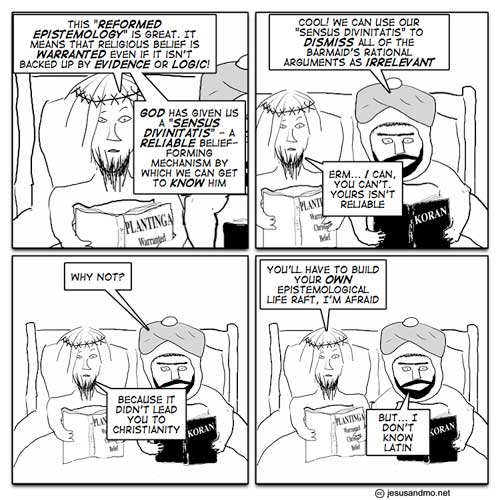
The most recent "Jesus and Mo" comic is slightly relevant, too:


It seems to me that the only way for religions to hold onto their influence and power is to create their own definitions of truth, which is exactly what we see in these creationist movements.

Wednesday, February 13, 2008

Fuck Religious Extremism


P.Z. Myers has a point:

The aggrieved Muslims are saying, "Mock our god and we will kill you." They have the goal of suppressing images they consider blasphemous.

The cartoonists are saying, "Threaten to kill us and we will mock your god." Obviously, they'd like to stay alive, but their goal in this context is to see their work disseminated widely.

[...]

It looks to me like a few relatively obscure cartoonists are crushing the fundamentalist Muslim world.

Mock away!

Thursday, November 1, 2007

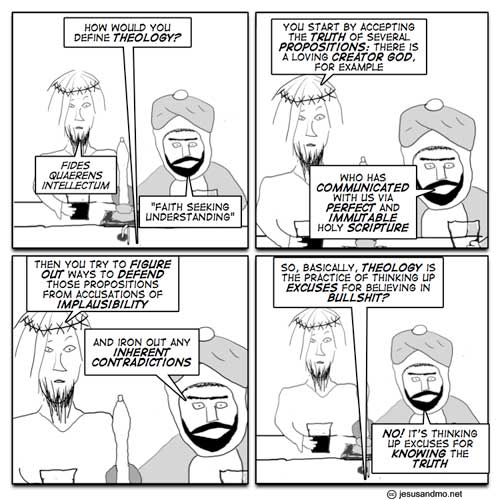
More 'Jesus and Mo' Goodness

This webstrip is increasingly becoming one of my favorites.


Further reading here.

Tuesday, October 23, 2007

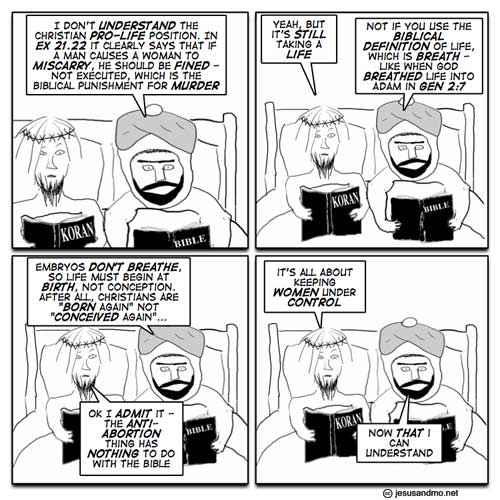
Anti-Choice Summed Up In Four Panels

The Golden Compass

I've come across the movie The Golden Compass, set to be released in theatres on December 7, 2007. The movie is a fantasy-themed story about the adventures of a young girl. The girl is given an object called "the golden compass," which is said to give a glimpse of the future. She is then approached by the leader of the Magisterium -- a group which aims to control all of humanity. Her adventure includes talking animals, armor-clad warrior bears, and a world of witches.

Why has this movie perked my interest? Because it's based on English writer Phillip Pullman's book trilogy His Dark Materials, a series of children's books based on anti-religious themes. Of course, such material has already drawn the ire of Bill Donohue, President of the Catholic League and all-around douche-bag. On October 9, 2007, Donohue told interviewer John Gibson of FOX News:

Look, the movie is based on the least offensive of the three books. And they have dumbed down the worst elements in the movie because they don't want to make Christians angry and they want to make money. Our concern is this, unsuspecting Christian parents may want to take their kid to the movie, it opens up December 7th and say, this wasn't troubling, then we'll buy the books. So the movie is the bait for the books which are profoundly anti-Catholic and at the same time selling atheism.
So Donohue is basically arguing that the filmmakers are trying to "trick" parents into letting their kids see this film, and then they'll buy the books for their kids and their kids will be "baited" into atheism.

Wow, that's fucking rich coming from Donohue. Isn't this what religion does in general? Children are tricked into believing in religion because their parents unquestionably subject them to such nonsense throughout their entire childhoods, while also telling their children that such nonsense is literally true. Most children are never given the opportunity to explore multiple religions, or to hear arguments against religion. This behavior is the definition of indoctrination. And now Donohue points the finger at Pullman, charging Pullman with the same behavior that religion has expressed for millenniums? Ha!

I think this is great. It's time we aimed literature at children that encourages thinking, instead of the rigid doctrines of religion. Besides, if religion is true, then no amount of criticism can deter humanity, right? What are the religious so afraid of?

Thursday, May 31, 2007

Science Is Not Religion

PZ Myers rules:

There is a fundamental contradiction [between science and religion]. Faith says that the way to get answers is by revelation, accepting authority, and dogma. Science says that the way to get answers is by examining the evidence critically, testing hypotheses with experiment in the natural world, and by constantly reevaluating and revising our ideas to make them more accurate. It isn't just that the two arrive at different, conflicting answers—for instance, that the earth is 6000 years old vs. 4.5 billion years old—but that their methods conflict. Scientists will not accept a random idea because someone contemplated and decided a deep "Truth" appealed to him: a kernel of observation and evidence is required.

It is disingenuous for Brownback to claim that science and religion do not contradict each other, given that religion contradicts itself. Which "same god" created the material order? Allah, Jehovah, Vishnu, Thunderbird, Jesus, Ymir? Which sect's interpretation will we accept: Catholic, Protestant, Sunni, Shi'a, Scientologist, Mormon? There are even two accounts of the creation in the book of Genesis that differ from each other greatly—which one is the "spiritual truth"? Most importantly, how will you objectively evaluate these explanations? [emphasis in original]

I couldn't have put it better myself. Myers rips apart an editorial by Senator Sam Brownback, printed in The New York Times. Read the whole thing.

And this hits on something that really bothers me -- when people call science a "religion." Science and religion couldn't be more opposed to one another even if they got up and clashed swords. Science is the antidote to religious inanity.

Enter the Blasphemy Chamber

I think this relates to a few of my most recent posts about the electoral system and religion rather well:

Wednesday, May 30, 2007

Philosophy of Epistemology

I've been wanting to get this post up for quite awhile now, but time hasn't permitted me to do so. Last week, I had a very interesting discussion with a good friend of mine on the train. The original topic concerned a statement made by Richard Dawkins, who famously equated the teaching of religion to children with abuse.

Dawkin's approach emphasized that religion's use of fear causes great mental abuse to children, but I took a different approach during this discussion with a friend. My argument for agreeing with Dawkins was as follows:

1. Deception is defined as misleading others to believe something to be true. As wikipedia states:
Deception is the manipulation of perception to alter thoughts and feelings through lies and cleverness. Deception involves concepts like propaganda, distraction and concealment. Fiction, while sometimes manipulative, is not a deception unless it is portrayed as the whole truth.
2. The question is, then, is deceiving children considered to be abuse? I would answer that it is. Under any definition of abuse, to be deceptive is to be emotionally and/or mentally abusive. Abuse is defined as using someone wrongly to one's own advantage. It can easily be argued that religion uses people to its own advantage through coercion. The Inquisition is a prime example.

3. Religion makes many claims about the universe, and also puts forth that these claims are truths. In other words, religion has made claims for which it also says are true.

4. In all the thousands of years that religion has been around, never once has religion provided any verifiable, empirical evidence to support these claims that it posits are true. Religions claim there is a god (or gods), yet they have never proven this claim. Under any logical framework, it is the responsibility for the one making the claim to provide the evidence to prove that the claim is true; it is not the responsibility of the person not making the claim to prove that the negative of that claim is true.

5. Since religion has not provided the necessary evidence to support its claims, yet religion still preaches these claims as truths, religion is being deceptive.

6. If religions are being deceptive, and if the teaching of deception amount to abuse, then the teaching of religion is abuse.
My friend raised some questions regarding epistemology -- namely that one cannot actually obtain an objective truth; therefore, one cannot be held accountable for claims that are believed to be true but not proven to be true. Because no one can analyze evidence through another's perception, we cannot know for certain that both are viewing the evidence in the same way; however, I would argue that with multiple, independent perceivers, we can verify that a piece of evidence is viewed virtually the same, and therefore, we can state that we are so reasonably close to the truth that we can call the evidence a truth. With each added independent perceiver, the chance of error decreases.

This is the basis of the scientific method -- which posits that we can only accept evidence for claims that are observable, repeatable, and verifiable. Science has a long track record of making claims, providing evidence to prove those claims, and altering those claims when new evidence arises that disproves the old evidence; we can say that science has a method to provide truths to a reasonable degree. Science also uses a transparent methodology, so that anyone with enough interest can repeat the experiments and observations used to prove claims. Religion has no such method in place, and is therefore unfit to make claims of truth.

Since religion has no such method to provide verifiable claims, since religion's claims in the past have been proven wrong again and again, and since religion continues to make claims that it states are true (but that religion cannot know for certain within a reasonable degree that those claims are true) then religion is being deceptive.

I only make the claim that religion cannot know that its claims are true because religion does not have a method with a proven track record for obtaining truths. To continue to make such claims is the very definition of being deceptive. I don't have to claim that religion's claims are false, because it is not my responsibility to prove the negative of their claims.

My friend would argue that I cannot prove that such deception is intentional, and therefore, I cannot call it abuse. Whether or not religion is intentionally deceptive is besides the point -- religion is still being deceptive, and religion still teaches that deception to children. Even if religion believes that such claims are true, then are then being self-deceptive and self-abusive. Religion, because it teaches claims that it cannot know to be true but still teaches those claims as truths, is both deceptive and abusive.

Why There Weren't Any Dinosaurs On Noah's Ark

I just came across this and had to share.


Tuesday, May 29, 2007

Answers in Genesis Opens The Creation Museum

PZ Myers' blog post on this subject is a must read.

I haven't read all the way through, but I felt the need to comment on something that Myers hits on early in his post. Some newspapers feel the need to give both "sides" the same validity by reporting in a "he said/she said" fashion. An example from The New York Times:

For the skeptic the wonder is at a strange universe shaped by elaborate arguments, strong convictions and intermittent invocations of scientific principle. For the believer, it seems, this museum provides a kind of relief: Finally the world is being shown as it really is, without the distortions of secularism and natural selection.
This kind of reporting is wide-spread across pretty much all subjects that journalists cover, and it's appalling. When something is blatantly false, a journalist shouldn't give those false claims the same weight as true claims -- yet, time and time again, journalists will do just that in order to appear "balanced." Not all topics are in dispute: some ideas and claims are demonstrably false, and it's a journalist's job to point that out.

But the quote above from the Times goes even beyond that kind of sloppy journalism. The quote appears to be giving more credibility to the false claims, considering that secularism and natural selection are described as "distortions" and that The Creation Museum is described as being "shaped by elaborate arguments, strong convictions and intermittent invocations of scientific principles." The reality couldn't be farther from the truth -- there's nothing scientific about The Creation Museum, there are no elaborate arguments, and the only strong convictions evident are those unsupported by empirical evidence.

All The Creation Museum has for visitors is a fistful of lies. Take a look for yourself, and read the response from the National Center for Science Education.

Wednesday, April 25, 2007

Harris/Sullivan Follow-up

I've been rather busy lately, so I'm late to post this. In case you haven't noticed, Harris has responded to Sullivan's last email. I think Harris gets to the heart of the matter with this paragraph:

You want to have things both ways: your faith is reasonable but not in the least bound by reason; it is a matter of utter certainty, yet leavened by humility and doubt; you are still searching for the truth, but your belief in God is immune to any conceivable challenge from the world of evidence. I trust you will ascribe these antinomies to the paradox of faith; but, to my eye, they remain mere contradictions, dressed up in velvet.
It is this kind of cognitive dissonance that worries me most regarding religious progressives. Partitioning their brains in order to preform such mental gymnastics must have some kind of negative cognitive effect in the long run. Why don't they just take the next logical step in their reasoning?

Friday, April 6, 2007

Sullivan Evades Challenges Posed By Harris

Yesterday, I blogged about an email exchange between authors Sam Harris and Andrew Sullivan titled, “Is Religion ‘Built Upon Lies’?” In my post, I quoted Harris’s more recent email, which laid out the most pressing questions unanswered by Sullivan that came out of the dialogue. Today, Sullivan writes back. Harris had previously asked Sullivan to consider the plausibility of these competing doctrines:

(1) There is no God.

(2) There is a God, but all of our religions have distorted Her reality. Jesus was just an ordinary prophet who happened to become the center of a myth-making cult. God loves everyone and has never been concerned about what a person believes. After death, all people, Christians and non-Christians, simply merge with the Deity in a loving embrace.

(3) Christianity is the one true religion, and Catholics have the truest version of it.
Instead of answering Harris honestly, Sullivan writes in his own answers, ultimately choosing these two:
(5) There is a God, but all of our religions have distorted Her reality. Jesus was a man more suffused with divinity than any other human being who has ever lived. God loves everyone and has never been concerned about what a person believes, except that a person know God and accept God's love freely and expresses that love toward everyone he or she encounters. Jesus uniquely showed us how to accept God's love and how to be worthy of it. After death, all people, Christians and non-Christians, simply merge with the Deity in a loving embrace. But Jesus was the proof that such love exists, and that it is divine and eternal, and that it cares for us.

(6) None of us knows anything about these things.

The only things different about Sullivan’s (5) from Harris’s (2) is that Sullivan has inserted “god’s love” into the doctrine, as well as assert the “divinity” of Jesus. Sullivan has evaded Harris’s original inquiry -- asking Sullivan which doctrine is the most plausible. Considering that all Sullivan has done is added to Harris’s (2) with more assertions that Sullivan accepts purely on faith, it is logical to assume that Sullivan finds Harris’s (2) more plausible than the other choices posed by Harris. My question is this: what explanation does Sullivan have to assume that his more complicated and fantastic (5) is more plausible than Harris’s simpler (2)?

And let’s address “the wisdom” of Sullivan’s (6), as he put it. Sorry, but I’m not convinced of the wisdom of holding two unequal ideas at a level playing field. On the one hand you have faith, which asserts that there is a god of some form or another, and which provides zero empirical evidence to back up its claim. On the other hand you have reason, which asserts that because there is a lack of evidence in faith’s claim, there is no reason to assume that a god could exist at all. Atheists don’t claim to not believe in god's existence, atheists claim to be convinced god doesn’t exist. There is a fundamental difference -- the burden of proof is on the theists to prove that their god exists. Atheists are convinced of god’s nonexistence for the same reasons that most people are convinced of the tooth fairy’s nonexistence.

Sullivan goes on to clarify why he speaks of “god’s love”:
For me, the radical truth of my faith is therefore not that God exists, but that God is love (a far, far less likely proposition).
Ok… so Harris asks Sullivan to answer with which doctrine he thinks is the most plausible, and Sullivan answers with one he made up himself, and one that he himself has stated is “a far, far less likely proposition”? I guess I’m having a hard time following the logic here because there is none. Sullivan continues:
But I believe it to be true - not as a fable or as a comfort or as a culture. As truth.

[…]

…Jesus lived[] a life full of love and friendship and self-giving, even to the point of non-violent submission to violence, as proof of God's love. I do not need the proof of miracles to believe this.

Sullivan has just stated that he believes god is love because he believes it to be true. So far, he hasn’t given any reason to hold onto faith here -- in fact, Sullivan even says that miracles are unnecessary for him to continue to believe this! So what, then, is Sullivan’s standard of proof? It seems as though anything could convince him. So what does Sullivan have to say about miracles, anyway?

The universe itself is a miracle to me. If there are aspects of it that science has not yet grasped but that believers have somehow glimpsed, then I am content to allow for the possibility of miracles. But I have not witnessed any but the normal ones: the miracle of the blossoms out of my widow at this time of year or the miracle that someone else actually loves me unconditionally, or the miracle of a newborn child. This is miracle enough for me.

Under this definition, almost anything would be a miracle to Sullivan -- even things that can be explained by modern science, like “the miracle of the blossoms out of my widow at this time of year”! To understand just how meaningless Sullivan’s definition of miracle is, consider the definition in the Merriam-Webster dictionary:
1 : an extraordinary event manifesting divine intervention in human affairs
2 : an extremely outstanding or unusual event, thing, or accomplishment

Sullivan also uses his completely meaningless definition to describe the universe itself as “a miracle.” Does this mean that Sullivan implicitly thinks the universe is meaningless? Probably not, but I couldn’t help but point out that Sullivan has applied a meaningless definition to describe something which he thinks holds meaning.

All that and I haven’t even gotten to the specific issues that Harris outlined for Sullivan to ponder! Sullivan does get to those, but doesn’t answer them all. Gee, I wonder why?

Sullivan completely evaded Harris’s pointed critique of his distinction between fundamentalism and moderation. Sullivan never once addressed his distinction between fundamentalism and moderation in terms of truth or falsity, as Harris had challenged him to do so. Sullivan answers the challenge by saying he’s already answered it -- once again confirming my suspicion that Sullivan doesn’t want to consider some questions because of where they might lead him.

Sullivan then addresses Harris’s challenge on the inadequacies of the Bible by stating that he doesn’t “believe in its inerrancy or its literal truth” but does “believe in the deepest truths of the Gospels, and the truth of the life and death of the man they describe.” This begs the question, what reason does Sullivan have to believe in only certain parts of the Bible? Considering that Sullivan is Catholic and that the pope has stated that the Bible is inerrant, how has Sullivan reasoned his intermediate position?

Another challenged posed by Harris is completely ignored, and this time it’s not even mentioned in Sullivan’s text. On the question of Sullivan’s claim that god is “definitionally” the creator of the universe, Sullivan says nothing. Sullivan must know the fault of his claim -- he's assuming god’s existence to claim god’s existence -- hence why he did not address the challenge. The question I have for Sullivan is this: for what reason do you have to believe that god is the creator of the universe by definition?

On Harris’s destruction of Sullivan’s argument that the success of the Christian religion is proof of its truth, Sullivan had this to say:
I agree that such success doesn't actually prove anything about a faith. But it is a sign that a truth has endured the test of time…

Sullivan just snuck one in there -- he agrees that his argument is bogus, and then without skipping a beat makes the same exact argument. How is Christianity’s success “a sign that a truth has endured the test of time” if the cultural success of Christianity doesn’t prove anything? Hasn’t Sullivan already conceded that cultural success doesn’t prove truth? Sullivan has just shown that he is assuming the “truth” of Christianity and that he is not open to the questioning of that “truth.”

The end of Sullivan’s email suggests that this exchange is coming to a close -- oh how I hope that that isn’t so! I really would like to see a point-by-point rebuttal from Harris. Sullivan’s email is just begging for it.

Wednesday, April 4, 2007

Sam Harris Dismantles Faith... Again

I read this email exchange between authors Sam Harris (The End of Faith, Letter to a Christian Nation) and Andrew Sullivan (The Conservative Soul) on science and faith. I have to say, I came away from the discussion feeling that Harris had effectively diffuses all of Sullivan's main points, as well as mount a serious case against faith itself. Sullivan doesn't put up much of an intellectual fight, and is evasive of the challenges posed by Harris for the most part. I'll quote at length the final issues that came out of the discussion that Harris sums up in his latest email:

Moderation v. fundamentalism: There appears to be no principled separation between religious moderation and religious fundamentalism other than a facility for (and an inclination to) doubt. But how much doubt is too much? Why not doubt the whole shebang, as I do? The pope seems to believe many things which you doubt. Do you have reason to believe that the pope is mistaken about the true doctrine of Christianity, or do you just not like the social consequences of some of his beliefs? Can you justify the intermediate position you've taken with respect to Catholicism in terms of truth and falsity (rather than consolation and its lack)? And if you disagree that the truth of an idea can be neatly separated from its consolations, what does the phrase "wishful thinking" mean to you?

The inadequacies of the Bible: What is the intellectual justification for considering the Bible to be the inspired word of God, given how much bad stuff (like slavery) is in there, and how much good stuff (like all of science) isn't? Do you really think that no mere mortals could have written Mark, Matthew, John and Luke? Not even the combined talent of a first-century Virgil, Dante, Shakespeare, and Tolstoy? It seems to me that this textual claim really lies at the core of the matter: either the Bible is a book like any other great work of literature, or it's a magic book. Once one accepts it to be a magic book, I agree that a wide range of religious implications follow; but if one doesn't accept this claim, it seems to me that the basis for being a Christian (as a opposed to anything else) evaporates. Would it really surprise you if God told you that the Bible was a product of fallible, human minds? And if this wouldn't truly astound you (in the way that finding out that George Washington never existed presumably would), how can you claim to be so certain of the doctrine of Christianity?

Ontological fancy footwork: All that business about God being "definitionally" the creator of the universe, outside of space and time, etc. just doesn't wash. The "marzipan at the center of the sun" is definitionally at the center of the sun. Does this mean there is marzipan at the center of the sun?

The contingency of your own faith: As you said, if you'd been raised a Buddhist, you'd probably be a Buddhist. And yet, you also believe that Christianity is really true. This seems to entail that, by sheer accident of birth, you were raised and culturally conditioned to believe the one true faith. Do you really believe this? Doesn't it seem more likely that you just happen to subscribe to the religion into which you were born (as most people do) because of social pressure, emotional consolation, attachment to tradition, etc.?

The troublesome example of other religions: Don't you think Mormons and Muslims have similar stories to tell about feeling consoled in the presence of death, hearing voices, etc.? Can't both Mormons and Muslims use the same argument you have used about the cultural success of their faiths to vindicate their own truth claims? How is it that you reject their claims, and how is it that in rejecting them you don't find your own religious beliefs coming under pressure?

The argument from cultural success: Apart from the fact that the argument from cultural success would vindicate any religion that has millions of subscribers, it's also just plain false. The success of Christianity (or any faith) is not an argument for its truth. While dialogue and consensus (and, therefore, cultural success) play a role in our knowledge gathering, we don't do epistemology by plebiscite. The majority of people really can be wrong-as are the majority of American Christians about the age of the universe and about the evolution of life on this planet.

Ancient miracles are less compelling than modern miracles (and modern miracles don't compel you): Christianity is predicated on the reliability of the gospel account of the miracles of Jesus. And yet, there are modern books cataloguing the miracles of Hindu adepts, written by educated Westerners. Why not grant these testimonials even more credence than the gospel? I would bet that you are not even inclined to read this literature, much less organize your life around it. Then why not view the gospel with the same skepticism?
I feel that Sullivan has avoided addressing these specific issues with specific answers because, being an intelligent person, he knows the logical binds that await him if he tries to weasel out a defense of faith. I'm eagerly awaiting for this exchange to continue...

Monday, March 26, 2007

Frank Miller's 300 Is... Religious?

Over at ScienceBlogs, I read a post pointing to a column by Rabbi Marc Gellman in Newsweek, which argues that in the film-adaptation of Frank Miller's 300:

The Spartan Greeks, led by Leonides, could have chosen to live under the rule of Xerxes and the Persian Empire. They could have traded their imperiled freedom for a secure life of slavery. The choice of Leonides and the 300 Spartans to die in a doomed but heroic battle is the clear choice of those who believe that nothing—no faith, no material wealth, nothing—justifies the surrender of freedom to tyranny.

[...]

Neither Leonides nor Captain America were religious, but both of them stood for that part of the religious world that believes in a God who fights for freedom. They both stood for the proposition that freedom is the foundation of all meaningful life. Religiously speaking, this is the belief that God gave freedom to all people made in His image, and that those who oppose freedom must be prepared to fight God. Leonides and Cap were echoing Moses' message to Pharaoh.

[...]

Leonides and Captain America were heroes not because they entered the field of battle with a shield of Vibranium or were in possession of abs of steel, but because they entered battle with a spiritually authentic idea: that God is free and we are made in God's image to be free as well. We were not placed on planet earth to avoid death. We were placed here so that we could avoid surrendering our God-given freedom to tyrants. [emphasis mine]
Aside from PZ Myers' odd claim that comic books (or graphic novels) have nothing to offer in terms of cultural/social/political commentary -- I point the reader towards the works of Alan Moore, especially V for Vendetta and Watchmen -- Gellman is projecting his faith onto a film which demonstrably rejects religion as the basis for which Leonidas fights for freedom.

I've seen the film twice in theatres since its release, and, if my memory serves correct, every single time a Spartan says they are fighting for freedom, the proclamation is coupled with reason/logic, democracy, and justice. Several times in the film, the Greeks are praised for their reason and logic as the basis of their culture and society -- not for their religion. Additionally, the religious figures in the film are portrayed as abnormal, mutated inbreds. Several times, Leonides calls them swine and he even ponders why these religious figures prevent him from marching to Thermopylae with his entire army to defend freedom. Furthermore, these religious figures can hardly be the poster-children for freedom or morality, considering that they require that the most beautiful Spartan girls serve as sexual slaves to them and that they will only give an audience with a bribe of gold.

It's also interesting to take Gellman's argument one step further -- that freedom is a gift from god. If this is true, why does Gellman's god impose rules (i.e. the Ten Commandments) which cannot be broken if one wants salvation? Doesn't sound a whole lot like freedom to me. In effect, Gellman is not "made in God's image to be free as well."

When I walked out of the theatre, I had a strong sense of anti-religious themes running through the film. But these are the kind of people who get a column over at Newsweek. Being a Rabbi doesn't make one an expert on religion any more than being a politician makes one an expert on government -- it just makes one a tool for the system in which one identifies.

Sunday, March 25, 2007

Religion is a Dead Weight

On Friday, I had a very interesting discussion with a co-worker which began about the over-representation of religious figures versus non-religious figures in the media on issues of "values" or "morality." She took the position that pitting religious figures from the left and the right is enough to have a balanced debate, but I had to disagree. What about the perspective from openly non-religious figures (i.e. atheists)? By only having religious figures debate these topics, the impression that religion has some sort of moral authority is created. As we discussed this, the conversation quickly turned into a debate over the intersection of religion and science, as well as the role of religion in regards to human progress.

Her position here was that progressive religious people are a step in the right direction -- progressive religious people meaning those who still hold the basic tenets of their faiths as true while at the same time accepting known science about the natural world that contradicts what is taught in their holy books. Religious pluralism is what she was arguing for, but again, I had to point out the corrosive effect even religious progressives have. Despite the fact that these religious progressives have attempted to negotiate their faith with science create a sort of cognitive dissonance. Why haven't these people taken the methodologies behind the science that they do accept and applied them to all aspects of their faith? It is and interesting question, and one that religious progressives appear unwilling to explore.

Over at ScienceBlogs the other week, I followed an interesting discussion on this very topic. One blogger, Rob Knop, wrote about how he has meshed his religious faith and this scientific understandings. Another blogger, Jason Rosenhouse, pointed out that Knop was conceding many things central to the faith he subscribed to in order to hold onto that faith. Eventually, we are told that the religious progressive has some sort of "spirituality," which another blogger, PZ Myers, describes accurately. My point is that religious progressives are forced to throw away central tenets of their faith in order to keep that faith in conjunction with science. Tenet after tenet is sacrificed... so why not just take this progression to its logical conclusion?

But back to the original topic: I was trying to show that religion no longer holds any kind of moral authority. In fact, every modern social advancement I can think of -- human rights, democratic government, social equality -- is conceived of by thinkers using the basic foundation of the enlightenment: logic, reason, rational thought, empiricism, and collection of evidence to prove theorems. Religion then adapts in order to survive, all the while holding onto the tenets that cannot be directly challenged by science and philosophy. I do believe that one day science and philosophical thought will replace religion completely -- both science and philosophy have mechanisms of improvement built into them as our understanding of the world becomes more complete, as well as have a foundation in the enlightenment thought process. These are much better sources for moral authority -- why turn to the bible, which is a document that cannot be viewed or analyzed in its original form or altered from its current state, when you can turn to a document like the US Constitution, which can be viewed in its original form and which can be altered as social/cultural institutions change?

Religion is a dead weight on the road to progress. Religion holds us back, and religious progressives are a part of the problem. Religious progressives give legitimacy to irrational ideas and help those ideas persist in the face of overwhelming evidence to the contrary. It is this religious dogma that slows down progress. Religious pluralism, while sounding very democratic, allows for things like the literal interpretation of the Bible to persist. Not all ideas are created equal, and not all ideas should be viewed as polar opposites of each other with the same validity. Religious ideas are at the bottom of the knowledge food chain -- they aren't based on anything over than blind faith. Scientific ideas are much different in that they are based on repeatable observations and natural phenomenon, supported by empirical evidence, and argued using rational and logical frameworks. Science and faith are not equal ideas, and science will trump faith every time.

Unfortunately, many people still hold onto these religious faiths, and it is slowing down our progress as a species. But the good news is that an increasing number of people are rejecting them on some level or another, and each new cohort is more progressive and less religious than the one before it. And with the proportion of atheists on the rise and the proportion of theists on the decline, isn't it about time that non-theists be given the same exposure and legitimacy granted to the theists in the media?