Showing posts with label journalism. Show all posts

Wednesday, June 18, 2008

Associated Press Attempts to Destroy Journalism

Patrick Hayden wrote on Monday that the Associated Press is now charging fees for individuals to quote as little as five words from AP articles. I'll borrow the graphic from Cory Doctorow to illustrate the insanity the AP has decided to spiral downwards into.
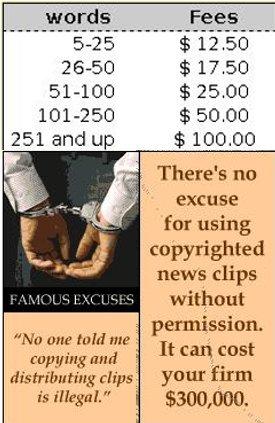
Furthermore, Hayden writes that the AP reserves the right to terminate any license if the user criticizes the AP. From the AP's Terms of Use:

You shall not use the Content in any manner or context that will be in any way derogatory to the author, the publication from which the Content came, or any person connected with the creation of the Content or depicted in the Content. You agree not to use the Content in any manner or context that will be in any way derogatory to or damaging to the reputation of Publisher, its licensors, or any person connected with the creation of the Content or referenced in the Content […]

Publisher reserves the right to terminate this Agreement at any time if Publisher or its agents finds Your use of the licensed Content to be offensive and/or damaging to Publisher’s reputation.

Whatever happened to fair use?
Section 107 contains a list of the various purposes for which the reproduction of a particular work may be considered “fair,” such as criticism, comment, news reporting, teaching, scholarship, and research. [emphasis mine]

Aren't those the activities that journalists, bloggers, and other interested individuals engage in when quoting a news story like those provided by the AP?

The AP has reported that the organization will be meeting with bloggers to address their "assertion of copyright." I'll quote the article at length, and without an unconstitutional license from the assholes at the AP:
The Associated Press, following criticism from bloggers over an AP assertion of copyright, plans to meet this week with a bloggers' group to help form guidelines under which AP news stories could be quoted online.

[...]

Wendy Seltzer, a legal scholar and a fellow at the Berkman Center for Internet and Society at Harvard University, said it was encouraging that AP wanted to find an arrangement with bloggers to facilitate a mutually agreeable way for them to use AP content.

But she cautioned that the news organization, a not-for-profit cooperative owned by its member newspapers and broadcasters, should not try to go beyond what's legally permissible.
And that's exactly what the AP is trying to do; the organization is trying to go beyond what is legally permissible. Moreover, the AP has proven itself unable to uphold journalistic standards and democratic ideals:
[Jim] Kennedy [AP Director of Strategic Planning] said the AP had both a journalistic concern about preventing AP news from being quoted out of context and also a business concern about protecting the value of AP's news from being diluted if its key elements are made available from places that aren't licensed.
Un-fucking-believable.

[UPDATE]: Michael Arrington of TechCrunch sums it up quite well:
The A.P. doesn’t get to make its own rules around how its content is used, if those rules are stricter than the law allows. So even though they say they are making these new guidelines in the spirit of cooperation, it’s clear that, like the RIAA and MPAA, they are trying to claw their way to a set of property rights that don’t exist today and that they are not legally entitled to. And like the RIAA and MPAA, this is done to protect a dying business model -- paid content.
[UPDATE 2]: The Associated Press capitulates.

Monday, April 7, 2008

The Media Have Failed Us

Required reading from Greg Greenwald:

In the past two weeks, the following events transpired. A Department of Justice memo, authored by John Yoo, was released which authorized torture and presidential lawbreaking. It was revealed that the Bush administration declared the Fourth Amendment of the Bill of Rights to be inapplicable to "domestic military operations" within the U.S. The U.S. Attorney General appears to have fabricated a key event leading to the 9/11 attacks and made patently false statements about surveillance laws and related lawsuits. Barack Obama went bowling in Pennsylvania and had a low score.

Here are the number of times, according to NEXIS, that various topics have been mentioned in the media over the past thirty days:

"Yoo and torture" - 102

"Mukasey and 9/11" -- 73

"Yoo and Fourth Amendment" -- 16

"Obama and bowling" -- 1,043

"Obama and Wright" -- More than 3,000 (too many to be counted)

"Obama and patriotism" - 1,607

"Clinton and Lewinsky" -- 1,079


There's another angle of critique that Greenwald neglects -- it's not just rampant narcissism on part of journalists, but the culture of corporate media.

Journalists are expected to contribute to the bottom line, i.e., turn a profit for the parent company. I wrote earlier about a survey which found that 91% of newspaper, magazine, TV, radio, and online journalists believed their top priority to be to "make [his/her] publication successful by creating appealing content for its audiences." Journalists have internalized the values of their owning corporation in lieu of their commitment, their civic duty, to provide to the public the necessary information to protect our democratic values and form of governance.

So, it's no wonder that the media have largely ignored the Department of Justice memo and neglected to cover of the occupation of Iraq more thoroughly as of late -- journalists think, for their own self-serving interests, that trivial matters like Obama's bowling score are more important to the American people than attacks on American civil rights and liberties.

Friday, March 28, 2008

Journalism In Trouble

Editor & Publisher reports on the 2008 PR Week/PR Newswire Media Survey. The most troubling part about the survey is this finding:

When asked to identify the most important aspect of their work, 91% of respondents say "make my publication successful by creating appealing content for its audiences" -- ahead of "educate and inform the masses," "break news," and "chronicle events as they happen." This finding, says the survey, suggests a significant level of commercial awareness on the part of journalists.
As Network predicted, Neil Postman warned, and Robert McChesney and John Nichols have identified, there are problems with corporate media -- chief among them being valuing the bottom-line over the free-flow of information to inform a democratic public.

The fact that 91% of respondents are more interested in making his/her respective publication successful rather than informative is depressing.

Wednesday, March 12, 2008

Monday, March 10, 2008

American Journalism Protects the Powerful

Glenn Greenwald wrote last week about Tucker Carlson's admission to a key criticism of American journalism -- that reliance on official sources leads to a less critical press which enables those in power to govern without accountability. Here's the transcript from the exchange between Carlson and UK reporter Gerri Peev about a comment that Peev published from an on-the-record interview with Barack Obama adviser Samantha Power [emphasis from Greenwald]:

CARLSON: What -- she wanted it off the record. Typically, the arrangement is if someone you're interviewing wants a quote off the record, you give it to them off the record. Why didn't you do that?

PEEV: Are you really that acquiescent in the United States? In the United Kingdom, journalists believe that on or off the record is a principle that's decided ahead of the interview. If a figure in public life.

CARLSON: Right.

PEEV: Someone who's ostensibly going to be an advisor to the man who could be the most powerful politician in the world, if she makes a comment and decides it's a bit too controversial and wants to withdraw it immediately after, unfortunately if the interview is on the record, it has to go ahead.

CARLSON: Right. Well, it's a little.

PEEV: I didn't set out in any way, shape.

CARLSON: Right. But I mean, since journalistic standards in Great Britain are so much dramatically lower than they are here, it's a little much being lectured on journalistic ethics by a reporter from the "Scotsman," but I wonder if you could just explain what you think the effect is on the relationship between the press and the powerful. People don't talk to you when you go out of your way to hurt them as you did in this piece.

Don't you think that hurts the rest of us in our effort to get to the truth from the principals in these campaigns?

PEEV: If this is the first time that candid remarks have been published about what one campaign team thinks of the other candidate, then I would argue that your journalists aren't doing a very good job of getting to the truth. Now I did not go out of my way in any way, shape or form to hurt Miss Power. I believe she's an intelligent and perfectly affable woman. In fact, she's -- she is incredibly intelligent so she -- who knows she may have known what she was doing.

She regretted it. She probably acted with integrity. It's not for me to decide one way or the other whether she did the right thing. But I did not go out and try to end her career.

Instead of holding the powerful accountable, the American press serves as a "holder of secrets" in return for access to official sources. Carlson's philosophy has major holes -- the idea that this kind of symbiotic behavior between the press and the powerful will yield truths is laughable. What reason would the powerful have to give up any truths on-the-record? The current model exempts the powerful from any public scrutiny -- the press have essentially given the powerful, willingly, their only mechanism for holding public officials accountable and there is little reason to think that accountability will be applied voluntarily.

Read the entire Greenwald post -- he goes on to talk about Tim Russert's admission in testimony during the Scooter Libby trial that all of this interviews with public officials are strictly confidential. Who does this man serve? Not the public.

Wednesday, August 22, 2007

The End of Journalism

This post over at QueerSighted.com makes some rather interesting observations:

It has become all too easy to shrug off the decline of legitimate news organizations and "old-fashioned" print media as the Internet and direct and digital cable TV expand by leaps and bounds. But the fact that we've reduced real news and truth to a consumer commodity subject to ratings and sales poses a threat to our freedom that is mostly ignored.
and here's how this threat has manifested itself:
[Rupert] Murdoch [owner of News Corp.] operates most of his major media properties at a loss, slashing ad rates and subscribers rates in order to drive the less well financed family-owned and journalist-owned properties into oblivion. That's his goal with The New York Times. Decades ago news outlets competed with each other through their ability to deliver the best information first, quality of writing and quality of investigative journalism. Today, the Murdoch's of the world have radically changed the paradigm forcing news outlets to compete as business entities mostly through advertising revenue. And with his deep pockets, Murdoch always has the advantage. Murdoch does not see his broadcast and print news ventures as a means to enhance the provision of free information to a free people, Murdoch rather uses his former news and information properties to propagandize his various political agenda--the anti-gay one for example--both through the dissemination of lies and the diversion of circus-like entertainment. And he's brilliant at this. Murdoch has done more damage to American democracy and freedom than a dozen George W. Bushes could ever hope to accomplish.
Why is this so important? Because without a free press there will be no one watching government. Those in a position of power will be able to abuse that power because no one is plastering their misdeeds all over the front pages for all Americans to read. Without an informed populace, voters cannot make sound decisions at the voting booth, and therefore, candidates will find it easier to lie to constituents about their intentions for office.

The blogosphere, while more democratic than traditional print newspapers, is missing something important -- credibility. People trust print news as a source for objective information because there are journalistic standards in place to ensure that that information is reliable. The methods that those like Murdoch engage in threaten to disrupt these journalistic standards, and thus, shift the focus of news gathering from keeping a watchful eye on power to more trivial pursuits, while also having the side effect of reducing the credibility of print journalism.

Tuesday, May 29, 2007

Answers in Genesis Opens The Creation Museum

PZ Myers' blog post on this subject is a must read.

I haven't read all the way through, but I felt the need to comment on something that Myers hits on early in his post. Some newspapers feel the need to give both "sides" the same validity by reporting in a "he said/she said" fashion. An example from The New York Times:

For the skeptic the wonder is at a strange universe shaped by elaborate arguments, strong convictions and intermittent invocations of scientific principle. For the believer, it seems, this museum provides a kind of relief: Finally the world is being shown as it really is, without the distortions of secularism and natural selection.
This kind of reporting is wide-spread across pretty much all subjects that journalists cover, and it's appalling. When something is blatantly false, a journalist shouldn't give those false claims the same weight as true claims -- yet, time and time again, journalists will do just that in order to appear "balanced." Not all topics are in dispute: some ideas and claims are demonstrably false, and it's a journalist's job to point that out.

But the quote above from the Times goes even beyond that kind of sloppy journalism. The quote appears to be giving more credibility to the false claims, considering that secularism and natural selection are described as "distortions" and that The Creation Museum is described as being "shaped by elaborate arguments, strong convictions and intermittent invocations of scientific principles." The reality couldn't be farther from the truth -- there's nothing scientific about The Creation Museum, there are no elaborate arguments, and the only strong convictions evident are those unsupported by empirical evidence.

All The Creation Museum has for visitors is a fistful of lies. Take a look for yourself, and read the response from the National Center for Science Education.